A Single Arm Robot can look simple on a factory floor: one mounted base, one moving arm, and a gripper placing a part into a fixture. Yet choosing the right design depends on reach, payload, speed, precision, and how people share the workspace. The International Federation of Robotics’ World Robotics 2024 report counted 4,281,585 industrial robots operating worldwide in 2023, with 541,302 new installations that year. Those figures cover industrial robots broadly, not single-arm models alone. Still, they show why buyers need clear comparisons rather than broad promises.
The main types include articulated arms for flexible, multi-axis work; SCARA robots for fast assembly; Cartesian robots for straight-line movement; and delta robots for lightweight, high-speed picking. Collaborative robots are another important option, though “collaborative” describes intended human interaction, not a distinct arm geometry. A useful distinction. IFR President Marina Bill described the wider market’s momentum this way: “The global economic slowdown has not affected the desire to automate.” In 2026, that demand makes application fit especially important. A heavy articulated arm may suit welding or machine tending, while a compact SCARA can handle small components on a tight bench. But product labels can overlap, and specifications do not always predict performance in a real cell. This guide compares the leading Single Arm Robot types by movement, typical tasks, and practical trade-offs, while noting where published market data does not isolate single-arm systems.
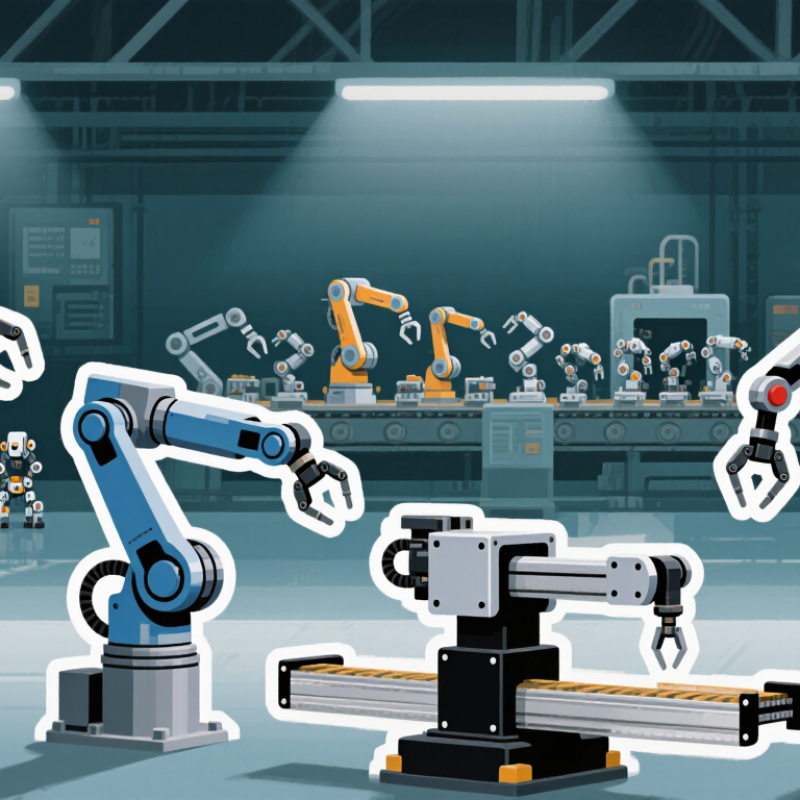
Articulated single-arm robots use a chain of rotating joints to reach around fixtures and approach a workpiece from different angles. Depending on the model, several axes can support tasks such as machine tending, pick-and-place, and assembly. A compact arm might load parts from a tray, rotate its wrist, then place each component into a narrow fixture. That flexibility is useful when product layouts change. But more axes do not automatically mean better results.
Selection should start with the task, not the robot’s advertised reach. Check payload, working envelope, repeatability, cycle time, and the weight of the tool attached to the wrist. A gripper or sensor changes the arm’s balance and can reduce practical payload. In a real cell, cables, guards, nearby equipment, and access for maintenance also shape usable motion. Simulate the full path before installation, then test representative parts. Small collisions and awkward service access are easy to miss on a screen.
Tips: Map the arm’s reach around the actual fixture. Leave room for tool changes and maintenance. Test the heaviest part, not just an average one. If a movement feels awkward, revisit the layout; a flexible arm cannot fix every poor workstation design.
Rotating joints let it reach around fixtures and approach parts from different angles. For example, it can lift a component from a tray and place it inside a narrow fixture.
Start with the task, then check payload, reach, repeatability, and cycle time. Include the wrist tool’s weight. A gripper can reduce the practical payload.
Cables, guards, nearby equipment, and maintenance access can limit movement. A simulation may miss awkward service access, so test the path with real parts too.
It suits fast, repetitive assembly and pick-and-place on compact lines. It can move a housing from a shallow tray and place it on a conveyor.
Slow grippers, flexible cables, and poorly arranged trays can limit the whole sequence. Test pickup and release delays with actual parts. Small details matter.
Delta robots often handle lightweight products, sorting, packaging, and transfers between nearby stations. Their low moving mass supports quick cycles within a defined work zone.
Belt vibration, uneven spacing, and surface friction can affect placement. An oversized gripper may also reduce speed. Speed alone is a shaky measure.
Run representative parts through the complete task, including the heaviest item and real pickup conditions. Check repeatability and maintenance access. I might still overlook something in a trial.
In 2026, choosing the right Single Arm Robot depends on the task, workspace, and required speed and precision. Articulated models offer flexible, multi-axis movement for handling varied tasks and reaching around obstacles. SCARA robots are well suited to fast assembly and pick-and-place operations, while Cartesian robots use precise linear motion for predictable, structured workspaces.
Other designs address more specialized needs. Cylindrical robots work within compact, radial areas, making them useful where floor space is limited. Delta robots combine a lightweight structure with rapid movement, supporting high-speed handling of small items. Understanding the strengths of each type helps match a robot to an application’s motion requirements, available space, payload, and cycle time. The best choice is the one that delivers the needed balance of reach, accuracy, and efficiency.

 ZHIYI Robotics