Industrial robot arms have moved from specialist production cells into everyday manufacturing. They now weld, assemble, paint, package, and handle delicate components. Their movements may look simple, but reliable performance depends on precise engineering, software, safety design, and maintenance support. Selecting the right Industrial Robot Arm is therefore more complex than comparing payload numbers. A machine that excels in automotive welding may perform poorly in electronics assembly. This guide introduces 10 leading industrial robot arm manufacturers worldwide and explains where their strengths usually appear. No single brand fits every factory.
The comparison considers payload, reach, repeatability, control systems, energy use, installation flexibility, and after-sales service. It also examines programming tools, spare-parts access, operator training, and compatibility with conveyors, vision systems, and other equipment. A factory floor tells a different story than a product brochure. Cycle time, cable wear, dust, heat, and unexpected stoppages can change the final decision. These practical details matter.
The selection draws on manufacturer documentation, industry experience, technical specifications, and widely reported market reputation. Still, some specifications are difficult to compare directly across brands. Marketing language can also hide important limitations. That deserves honest attention. Buyers should validate performance through demonstrations, pilot testing, reference visits, and total-cost calculations. A lower purchase price may become expensive after installation. Conversely, a premium system may offer little value for a simple task. This overview provides a professional starting point, not a universal ranking. Each manufacturer deserves evaluation against the application, workforce, facility conditions, and long-term production goals.
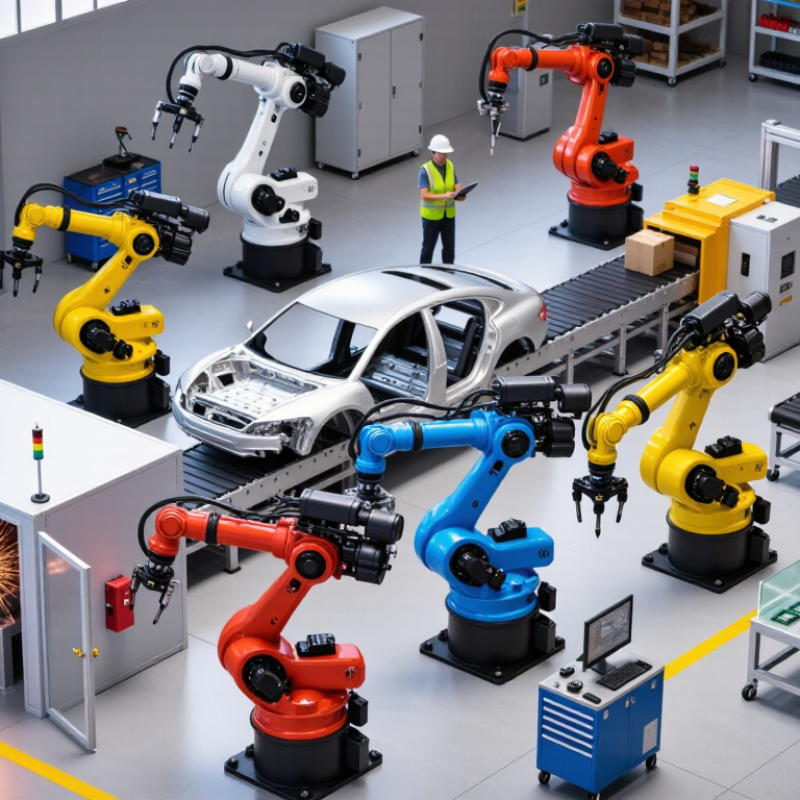
What Makes an Industrial Robot Arm Manufacturer a Global Leader
What Makes an Industrial Robot Arm Manufacturer a Global Leader
A global leader is not defined by arm speed alone. It must deliver repeatable accuracy across factories, climates, and production shifts. The International Federation of Robotics reported
541,302 industrial robot installations worldwide in 2023. More than
4.2 million industrial robots were operating globally. These figures show the market’s scale, but they also expose a hard truth: equipment failure can disrupt entire production lines.
The International Federation of Robotics reported 541,302 industrial robot installations worldwide in 2023. More than 4.2 million industrial robots were operating globally.
Reliable manufacturers design for measurable uptime, simple maintenance, and safe human interaction. A technician should reach a motor or cable without dismantling half the arm. Controllers need clear diagnostics, secure software updates, and compatibility with common factory systems. Safety performance should align with recognized standards, including ISO 10218 and ISO/TS 15066. Claims need evidence from endurance tests, field data, and documented service records.
Global support matters just as much.
Spare parts, local engineers, training, and response times often decide whether a promising system succeeds. The International Federation of Robotics also identifies automotive, electronics, and metal industries as major adoption sectors, each requiring different payloads and cycle patterns. A strong manufacturer listens before selling. That sounds basic. It is often missed.
No supplier is perfect. Integration can take longer than planned, and software learning curves remain real. Buyers should examine independent test results, warranty terms, total operating costs, and customer references. A polished demonstration is useful, but production-floor evidence is better.
Main Types and Technologies Used in Industrial Robot Arms
Industrial robot arms differ mainly in structure, reach, speed, and control needs. Articulated arms use several rotary joints, much like a human shoulder and elbow. They handle welding, painting, assembly, and heavy material movement. SCARA robots suit fast horizontal assembly and precise insertion tasks. Their stiffness helps when placing small components repeatedly.
Delta robots use lightweight parallel links above a conveyor. They can sort food packs or electronic parts at remarkable speed. Cartesian robots move along straight X, Y, and Z axes. Their motion is easy to understand, measure, and maintain. Collaborative arms use torque sensing and monitored speed limits. They can work near people, but safe operation still depends on risk assessment and correct installation.
Modern arms combine servo motors, absolute encoders, and motion controllers. These systems continuously adjust position, speed, and acceleration. Vision cameras help robots locate parts when fixed positioning is unreliable. Force-torque sensors detect contact during polishing, insertion, or delicate handling. Digital twins can test reach and collision risks before physical deployment. However, simulation is not reality. Dust, cable drag, lighting changes, and worn grippers still create surprises. In practice, choosing an arm requires checking payload at full reach, cycle time, workspace limits, maintenance access, and operator training. A faster robot may perform poorly if its gripper cannot hold the product securely.
Profiles of the Ten Leading Manufacturers Worldwide
Profiles of the Ten Leading Manufacturers Worldwide
The global industrial robot market is becoming more specialized, not simply larger. The International Federation of Robotics reported 541,302 industrial robots installed worldwide in 2023. It also recorded more than 4.28 million robots operating globally. These figures show strong demand, but they hide important differences between manufacturers.
The ten leading manufacturers generally divide into clear strengths. One specializes in compact assembly arms for electronics. Another focuses on heavy payload systems for automotive plants. A third develops fast pick-and-place robots for packaging lines. One is known for welding precision and stable arc control. Another builds cleanroom systems for semiconductor production. A sixth emphasizes collaborative arms with force sensing. One manufacturer concentrates on palletizing and end-of-line logistics. Another integrates vision software with flexible motion control. A ninth serves harsh environments, including foundries and metal processing. The tenth competes through modular platforms, easier maintenance, and regional support. These profiles are practical, but not perfect. Product comparisons can change quickly after software updates, acquisitions, or supply disruptions.
Tips: Compare payload, reach, repeatability, cycle time, safety functions, and service coverage. Check the manufacturer’s test conditions. They are rarely identical.
For reliable selection, buyers should verify performance through site trials and independent acceptance tests. ISO 10218 safety requirements matter, but implementation depends on layout, tooling, guarding, and worker training. The IFR data confirms market scale; it does not prove that the largest supplier fits every factory. Real production evidence remains more persuasive than a polished specification sheet.
10 Best Industrial Robot Arm Manufacturers Worldwide
Regional Distribution of Industrial Robot Installations in 2023
Asia accounted for the largest share of industrial robot installations worldwide in 2023, followed by Europe and the Americas. This regional distribution highlights where demand for industrial robot arms is most concentrated across manufacturing industries.
Source: International Federation of Robotics, World Robotics 2024. Percentages are rounded regional shares of global industrial robot installations in 2023.
Key Industries and Applications for Industrial Robot Arms
Industrial robot arms serve different industries because their motion, payload, and tooling can be adapted to specific production demands. In automotive plants, they weld frames, apply adhesives, handle heavy panels, and position components with repeatable accuracy. Metal fabricators use them for cutting, grinding, polishing, and machine tending. These tasks reduce exposure to heat, sharp edges, and repetitive strain.
Electronics manufacturers need smaller arms with precise movement and clean operating conditions. They place circuit components, inspect connections, and test delicate assemblies. Food processors use stainless-steel arms for packing, sorting, and palletizing. Washdown resistance matters here. Pharmaceutical facilities often require controlled environments, traceable processes, and careful material handling. A suitable end effector can prevent contamination and product damage.
Warehouses use robot arms to sort parcels, build pallets, and load irregular cartons. Vision systems help them recognize changing shapes, but they are not flawless. Poor lighting, reflective surfaces, and damaged labels still cause errors. In my experience, selecting a robot involves more than comparing speed ratings. Reach, payload, cycle time, floor space, safety fencing, and maintenance access all affect actual performance. A fast arm may waste time if operators cannot service it easily. Small pilot runs reveal these weaknesses. That lesson is easy to overlook.
How to Compare Manufacturers and Choose the Right Supplier
When comparing the 10 best industrial robot arm manufacturers worldwide, avoid ranking by name recognition alone. The IFR World Robotics 2024 report recorded 541,302 industrial robot installations in 2023, showing a crowded, fast-moving market. That scale makes supplier selection a process decision, not a catalog decision. Start with the task. Record payload, reach, cycle time, wrist moment, repeatability, washdown needs, and operating shifts. A six-axis arm may look suitable on paper, yet cable routing or gripper weight can reduce real throughput. Ask for a time-stamped cycle test using your parts.
Compare controllers and software as carefully as mechanics. Check offline programming, vision compatibility, PLC communication, error logs, cybersecurity controls, and recipe changes by operators. Published repeatability figures matter, but uptime data matters more. Request mean time between failures, response-time targets, local engineer coverage, spare-parts stock, and training hours. These details expose ownership risk. Service quality is often underestimated.
Use a weighted scorecard based on application fit, service, integration, lifecycle cost, and training. Suggested weights are 30%, 25%, 20%, 15%, and 10%. These weights are only a starting point. Calculate energy, gripper replacement, software licenses, calibration, downtime, and technician travel over seven years. Pilot one cell before signing a fleet contract. Measure actual OEE for four weeks. Do not trust a polished demo. IFR also reported global robot density of 162 units per 10,000 manufacturing employees in 2023, reminding buyers that operator readiness must accompany equipment investment. Some evaluations still underweight training. That is an avoidable mistake.
FAQS
More than 541,000 industrial robots were installed worldwide in 2023. Over 4.28 million robots were operating globally. The figures show demand, not universal suitability.
Compare payload, reach, repeatability, cycle time, safety functions, and service coverage. Test conditions often differ. Specifications can mislead.
Automotive plants use them for welding, adhesive application, and heavy-panel handling. Metal factories use them for grinding, cutting, polishing, and machine tending.
Electronics production usually needs compact arms with precise movement. They place components, inspect connections, and handle delicate assemblies. Clean operating conditions matter.
Food facilities use stainless-steel arms for sorting, packing, and palletizing. Washdown resistance is important. Hygiene failures can disrupt production quickly.
They need controlled environments, traceable processes, and careful material handling. Suitable end effectors can reduce contamination and product damage. Small details matter.
No. Poor lighting, reflective surfaces, and damaged labels can cause recognition errors. A changing carton shape may still confuse the system.
Run site trials and independent acceptance tests before full deployment. Check real cycle times, maintenance access, and operator interaction. Paper results are not enough.
ISO 10218 requirements are important, but layout, tooling, guarding, and training affect implementation. Safety depends on the whole workcell. Standards cannot fix poor planning.
Not necessarily. A fast arm may lose time when technicians cannot reach its service points. Pilot runs reveal weaknesses. I would still question early conclusions.
Conclusion
This article explores what makes an Industrial Robot Arm manufacturer a global leader, including engineering expertise, product reliability, automation software, safety standards, customization capabilities, and worldwide service support. It explains the main types and technologies used in industrial robotics, such as articulated, SCARA, delta, and collaborative systems, while highlighting advances in vision guidance, motion control, sensing, and intelligent programming.
The article also presents profiles of ten leading manufacturers worldwide without focusing on brand names, emphasizing their technological strengths, production capabilities, and market specialization. It examines how industrial robots support key industries such as automotive, electronics, logistics, food processing, pharmaceuticals, and general manufacturing. Finally, it provides practical guidance for comparing suppliers by evaluating payload, reach, accuracy, cycle time, integration support, maintenance, training, total ownership cost, and long-term scalability, helping businesses select the right solution for their operational goals.

 ZHIYI Robotics