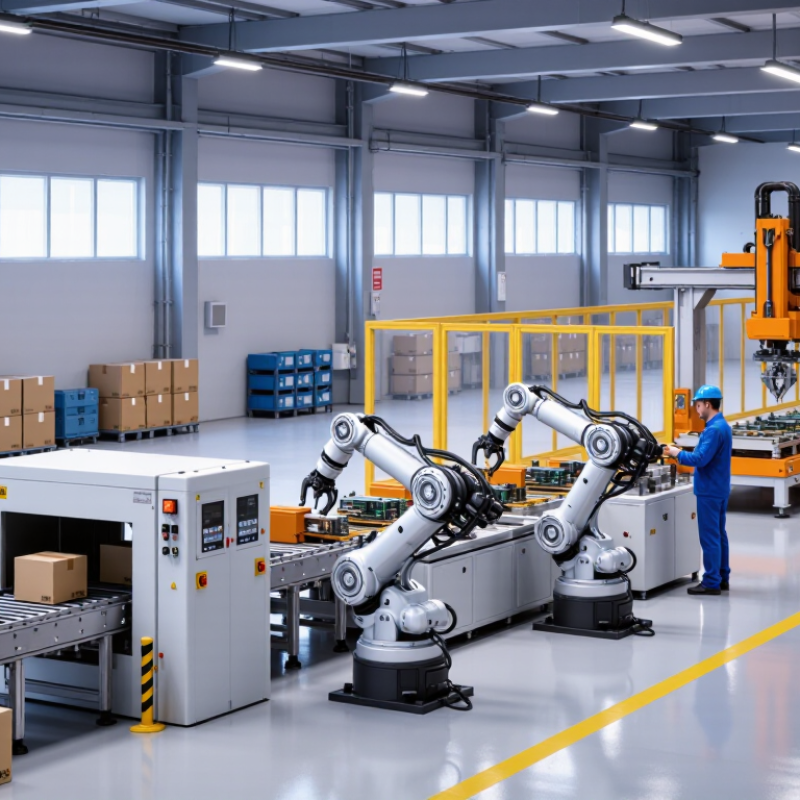
Choosing the right Robot Axis in 2026 is not simply a matter of counting movement directions. It is a production decision shaped by payload, reach, speed, accuracy, floor space, and maintenance access. A packaging line may need a compact four-axis robot, while a precision assembly cell may require six-axis flexibility. The correct choice begins with the task, not the catalog.
Real factory experience shows that small details often decide performance. A robot carrying a 12-kilogram tool may need more capacity than its stated load suggests. Cable routing, wrist torque, emergency stops, and daily cleaning also affect reliability. Even a well-designed system can lose efficiency when operators cannot reach filters or inspect joints safely. These practical conditions deserve the same attention as cycle time.
There is no universal best Robot Axis. That assumption can lead to expensive redesigns. Six-axis robots offer broad orientation control, yet they may add programming complexity and maintenance costs. Cartesian systems can deliver excellent repeatability, but their fixed structure may limit future product changes. In 2026, integrators should compare simulations, real workspace measurements, and verified supplier data before choosing. A short trial with the actual gripper and workpiece can expose problems that software misses. Do not trust estimates alone. Reflect on failure points, operator feedback, and expected production changes. The strongest decision balances present output with tomorrow’s uncertainty.
How to Choose the Right Robot Axis in 2026?
Robot axes describe how many independent movements a robot can perform. They directly shape reach, flexibility, speed, and installation cost. A one-axis system usually handles simple rotation, such as turning a fixture or positioning a workpiece. Two- and three-axis robots suit linear transfers, loading tasks, and repetitive pick-and-place operations. A four-axis robot adds wrist rotation, making it useful for fast assembly, sorting, and packaging. Six-axis robots provide greater freedom. They can approach parts from different angles, reach around obstacles, and support welding, inspection, or complex handling.
The correct choice depends on the industrial role, not only the axis count. A six-axis robot may solve difficult movements, but it can add programming time, maintenance demands, and unnecessary expense. A compact four-axis model may work better beside a conveyor with limited floor space. Check payload, working envelope, cycle time, tool weight, and required positioning accuracy. Also inspect the plant environment. Dust, heat, vibration, and narrow access points can change the practical decision.
One detail I often recheck is wrist clearance. It is easy to overlook.
Tips: Map every required movement before selecting hardware. Mark the robot base, conveyor, fixtures, and safety zones on a simple floor plan. Test the hardest motion, not the easiest one. Leave some capacity for future tooling. Still, predictions can be wrong. Production changes, and a robot chosen for today may struggle next year. Ask operators to review the motion path; their practical feedback often exposes awkward reaches and slow manual steps.
 ZHIYI Robotics